In Memoriam
Trooper
Wayne W. Allman
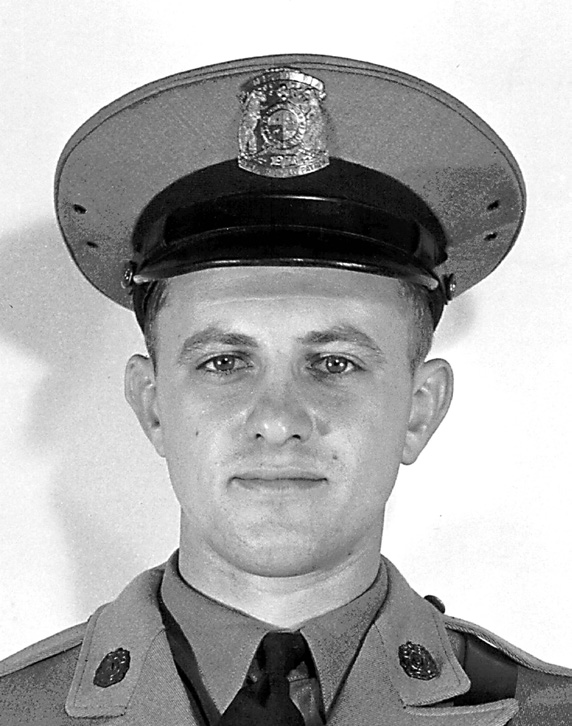
Badge #97 End of Watch: October 27, 1955
Remembrance
Wayne William Allman was born October 24, 1921, in Aurora, MO, the youngest of two children to Montie Raymond and Anna “Marie” Beyer Allman. Montie Allman, a barber, was the son of a Presbyterian minister. Mr. Allman owned his own shop for many years before barbering at the Tuberculosis Sanatorium in Mount Vernon, MO, where Mrs. Allman worked as the head housekeeper. Mrs. Allman was a devout Presbyterian who did not believe her children should have jobs requiring them to work on Sundays.
Wayne Allman and his sister, Loraine, who was two and a half years his senior, were inseparable growing up in Aurora, which caused many people to mistakenly believe they were twins. The Allmans were very family-oriented, and music was a constant in their lives. Wayne and Loraine grew up in the house next door to their maternal grandparents, a block from their paternal great-grandparents, and two blocks from their paternal grandparents. Wayne’s father played the mandolin; his mother, sister, and aunt played the piano; his uncle played the violin; and Wayne sang.
The family regularly played and sang together throughout their lives as they entertained their Aurora neighbors and friends. Wayne played both basketball and football at Aurora High School where he was selected president of the senior class, as was his sister before him. He graduated from Aurora High School in the class of 1939, along with Wava Ruth George. Wava’s father, Harvey George, was an original member of the Missouri State Highway Patrol stationed in Aurora.
On July 3, 1940, Wayne and Wava were married in Aurora. Wayne worked at the Wilson Grocery Store in Aurora from December 1939 to December 1940, when he moved to Tulsa, OK, to work at a Safeway Grocery Store where he made three dollars a week more than the grocery in Aurora paid. Wayne’s sister, Loraine, married Robert Conner in May 1939, with Wayne and Wava standing beside them. Mr. Conner followed Wayne to Tulsa and found employment of his own where Loraine later joined him.
In August 1941, Wayne left Tulsa and returned to Aurora where he went to work for Empire District Electric Cooperative as a bookkeeper. On May 13, 1942, a son, Gary Wayne, was born to Wayne and Wava Allman. On April 16, 1945, Wayne began serving in the United States Navy as a member of the Seabees. A second son, George Raymond, was born on October 12, 1945, while Wayne was in the service.
His military career was short-lived due to the end of World War II. He was honorably discharged on April 3, 1946. He then returned to Empire District Electric Cooperative in Aurora and immediately applied to the Missouri State Highway Patrol. On July 1, 1946, Wayne Allman entered the Patrol Academy at Cuivre River near Troy, MO. On August 10, 1946, Trooper Allman was sworn in and graduated with 61 of his classmates.
Tpr. Allman was assigned to Troop A and stationed in Sedalia. He began his duties on August 20 working with Sergeant Fred Rodecker and Trooper Pete Stohr. Tpr. Allman quickly established himself as a solid young officer and valuable asset to the Patrol. Tpr. Allman resumed his athletic career as a member of the Patrol on a basketball team sponsored by the Sedalia Police Department and coached by the chief of police.
Tpr. Stohr joined Tpr. Allman on the team along with members of the police department and area players. Since Troopers Allman and Stohr were regularly on patrol during the games the police chief would assign someone to listen to their patrol car radios while they played. Tpr. Allman was an exceptional athlete who excelled in his basketball performance. In 1950, it became necessary to move a trooper to Clinton, MO, in Henry County due to an opening created by the promotion of another officer.
Tpr. Allman was selected and agreed to move his young family there on September 15, 1950. Tpr. Allman’s interpersonal skills and caring personality generated many notations of thanks from those he assisted. He received four, separate letters of thanks from a single traffic crash he investigated involving a bus en route to a conference. Tpr. Allman’s love of sports never waned as he was an avid fan of the St. Louis Cardinals baseball team and listened to the games on the radio whenever the opportunity presented itself.
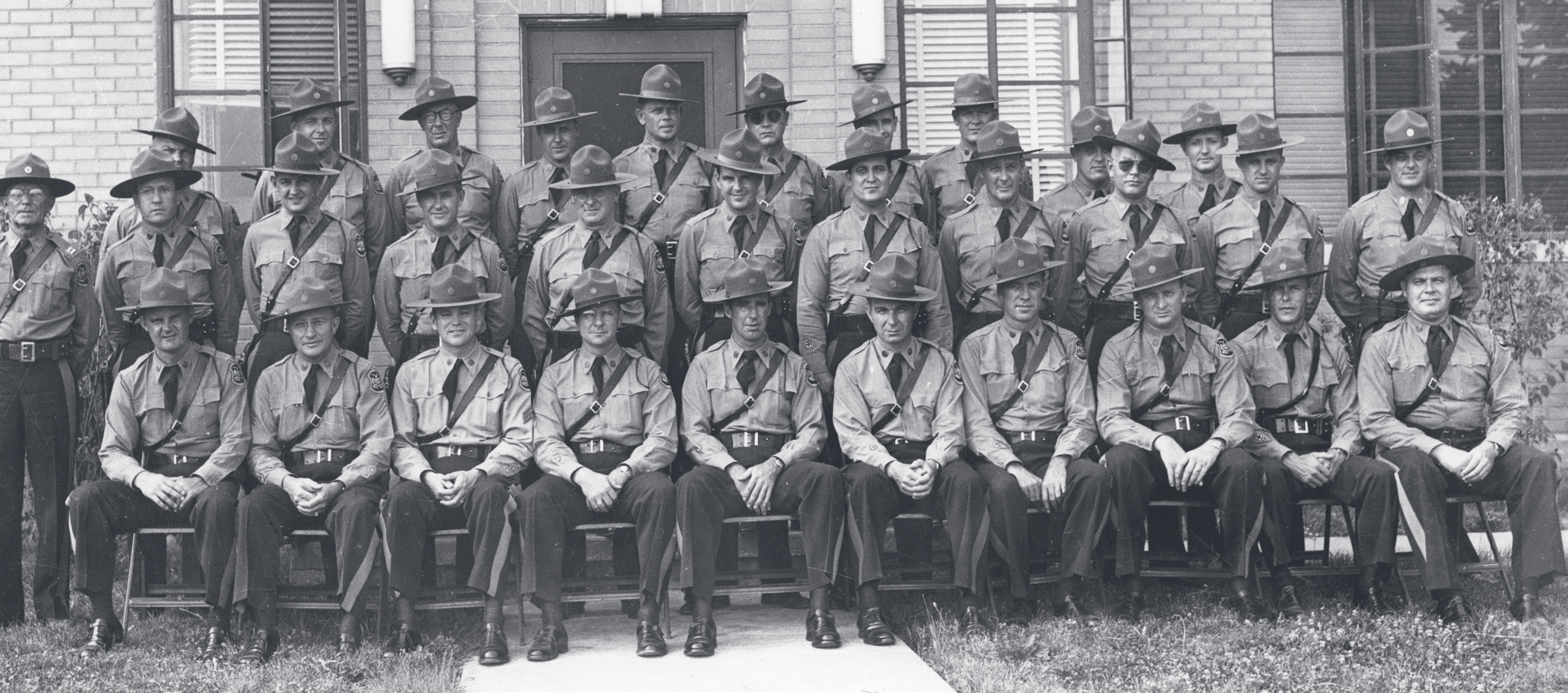
Tpr. Allman and his son, Gary, were listening to a double-header on May 2, 1954, when the Cardinals were playing the New York Giants. The Giants would go on to be world champions that year. That day was to belong to the Cardinals and more specifically to their star outfielder Stan Musial, who hit five home runs in the two games to set a record that stands to this day. On July 12, 1955, Tpr. Allman and Gary listened to the All-Star game, as the National are: J.K. Hightower, R.E. Davis, J.F. Watkins, E.V. Nash, A.F. Closson, E.C. Hammerand, S.S. Abney, W.A. Crowder, R.M. Rider, R.G. Place; second row: O.L. Viets (commanding officer), H. Walker, C.A. Pohle, M.F. McClure, H.H. Holt, R.M. Laurie, E.A. Butler, R.D. Killgore, G.V. Means, W.W. Allman, C.R. Oliver; third row: D.S. Gehrig, S.S. Smith, A.H. Bell, D.E. Millsap, G.W. Downing, C.W. Keith, K.C. Kerns, MB.
Roberts, W.J. Maloney, G.E. Phipps. League and American League were tied 5 to 5 in the 12th inning. Once again, Stan Musial was the hero when he hit a home run in the bottom of the inning to seal the victory. Gary’s memory of seeing his father ecstatic over the All-Star game home run would stay with him for a lifetime.
George Allman remembered watching as his father and brother played catch in the yard and lying on the floor with Gary as they watched Friday Night Fights on television with their dad. The boys would earn allowance money by helping him shine his duty leather and boots. Unfortunately, the occasions from which to draw memories were quickly coming to a close. On Thursday, October 27, 1955, Tpr. Allman was on patrol in Cass County when he received a call of an traffic crash on Missouri Highway 13 south of Clinton in Henry County.
With emergency equipment activated Tpr. Allman drove south on Missouri Highway 35 (now Missouri Highway 7) en route to the crash. At approximately 1:45 p.m., Tpr. Allman approached the intersection of MO 35 and Route B near Creighton, MO, when a northbound pickup truck turned onto Route B into his path. Tpr. Allman swerved and missed the pickup then swerved back to avoid striking a second northbound vehicle behind the pickup. The rear of Tpr. Allman’s car just caught the front of the northbound car.
The impact caused Tpr. Allman’s patrol car to careen down the highway and overturn. Tpr. Allman was ejected from his patrol car. He became the seventh member of the Missouri State Highway Patrol killed in the line of duty despite all efforts to save his life. At the time of the crash Gary Allman was at school playing baseball and George Allman was in class.
The Allman boys were told to go home without instruction as to why. Gary recalled walking the three blocks to their residence and sitting on the couch with George waiting for their mother to arrive while they watched the Mickey Mouse Club television show. Eventually, Wava Allman came home and told her sons, ages 13 and 10, their father was gone. The following day, the Clinton Daily Democrat printed an editorial about Tpr. Allman that read in part: If the person who dreamed up Missouri’s State Highway Patrol also envisioned a patrolman who would be as perfect as a mortal might be in that job, that would be Wayne Allman.
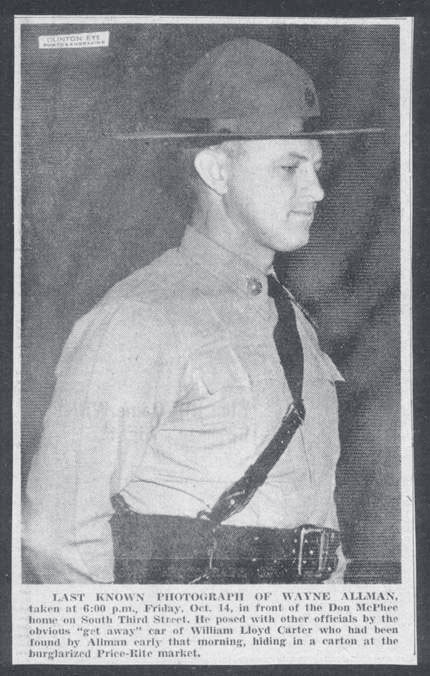
Wayne looked the part of a patrolman. He had the very rare ability of being able to arrest a person and bring him in smiling. He exercised authority with the deft touch of a diplomat—yet there was no question in the mind of the party concerned that the trooper was capable of peeling off the velvet glove and revealing an iron fist if necessary. He was fair, too, as many a prisoner will testify. area newspaper only weeks before Tpr. Allman was killed in the line of duty.
He was incorruptible, was unfailingly courteous—and was always ready day or night to the call of duty. As in the case of too many of our public servants, if salary were the full reason for doing the job, the service Wayne rendered to the people of Henry County and Missouri would never have been justified. Wayne’s final act epitomized the type of service he rendered. This final effort cost him his life.
A study of the accident scene shows that he could well be alive today if he had collided with either vehicle. But danger to the lives of others was something Wayne Allman had always fought. He died in the line of duty continuing his fight to the end. His monument will be in the memories of those who knew him.
Tpr. Allman’s funeral was held at the Clinton First Baptist Church on Saturday, October 29. Following the funeral service the procession left the church en route to the Aurora Maple Park Cemetery, a distance of well over 100 miles. As the procession moved slowly along the route, officers stood at attention at each intersection. The long procession and memory of the many officers stationed along the route left a lasting impression on the family members.
At the time of Tpr. Allman’s death, Wava Allman was employed part-time teaching sewing at the Singer Sewing Machine Company in Clinton. A Patrol Benefit Fund had been established and provided some immediate funds to assist the Allman family, and worker’s compensation benefits provided some assistance. But, the family quickly realized their lives would change. Both of the boys took jobs shortly after their father’s death, and Wava Allman went to work in the Henry County Courthouse.
The Henry County Prosecuting Attorney William Cason had become a close friend of Tpr. Allman and was at the hospital in Clinton when Tpr. Allman was brought in. Mr. Cason quickly realized the need to establish assistance for the family and specifically for the Allman boys’ future. The driver of the vehicle who turned in front of Tpr. Allman was uninsured. Mr. Cason took over the legal needs for Wava Allman and eventually filed a lawsuit against the driver of the vehicle struck by Tpr. Allman for not yielding to the emergency vehicle.
A jury trial was held in Henry County, but the jury ruled in favor of the other party. Following a reversal, on appeal, a small settlement was reached. Mr. Cason established a trust fund for Gary and George and wrote letters detailing how contributions could be made. Young Gary Allman was impressed with Mr. Cason’s handling of the legal proceedings on behalf of the family, and decided at that time he wanted to become an attorney.
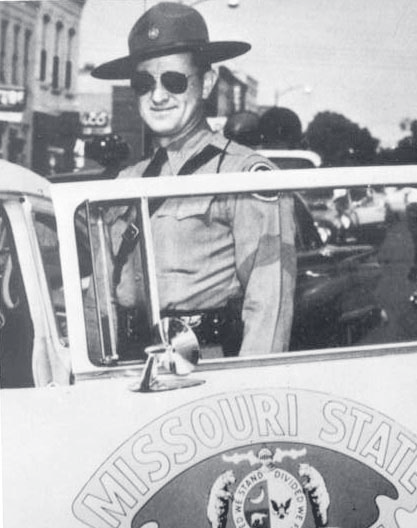
William Cason dedicated many hours to the Allman family and never charged them for any of his services. The Patrol realized the need to secure officers in their cars, and as a result of Tpr. Allman’s crash seat belts were installed in The Clinton Daily Democrat described Tpr. Wayne Allman as a patrolman “as perfect as a mortal might be in the job.” all patrol cars by the end of 1955. Unfortunately, their installation was too late for Tpr. Allman. Even with the installation of seat belts and the routine exposure to traffic crashes as participants and investigators, Patrol officers were slow to realize the importance of this added feature.
It would not be until the mid-1980s that our officers would customarily utilize seat belts for their own safety. Wava Allman was committed to remaining in Clinton, so her sons could finish high school there. Gary Allman possessed his father’s aptitude for athletics and starred in baseball and football while in school. He started on a Clinton High School football team that won 19 straight games including his last game, which was a 66-0 victory over Holden.
George was unable to participate in competitive sports due to Osgood Slaughters disease, which is an adolescent inflammation of the growth plate below the kneecap. Both Gary and George were industrious and financed their way with jobs while they attended school. George began a paper route when he was 11 and Gary worked in a grocery store before beginning construction work. George began shining shoes at Lee Miller’s barbershop in Clinton and started a carry-in business where he would walk to the businesses around the square and pick up shoes and bring them back shined.
George later went to work at a shoe store in Clinton. George recalled he was always treated well by the citizens of Clinton, he believed, out of respect for his father. Wava Allman dedicated her life to her sons. She never remarried and tried to fill the role of both parents.
The family became so busy, mealtime became the one time they could interact with each other about their activities. George recalled that when he would get up in the morning his mother would already be up ironing clothes. Wava Allman stayed in Clinton until her sons graduated. She then moved to Jefferson City where she was employed by the Traffic Division of the Missouri State Highway Patrol.
She later became one of the first female driver examiners and transferred to Troop D, Springfield. She retired from the Missouri State Highway Patrol on June 30, 1986. Both Allman boys attended ROTC in school and at the University of Missouri- Columbia. Gary graduated from MU in 1964 with a bachelor’s of science degree in business.
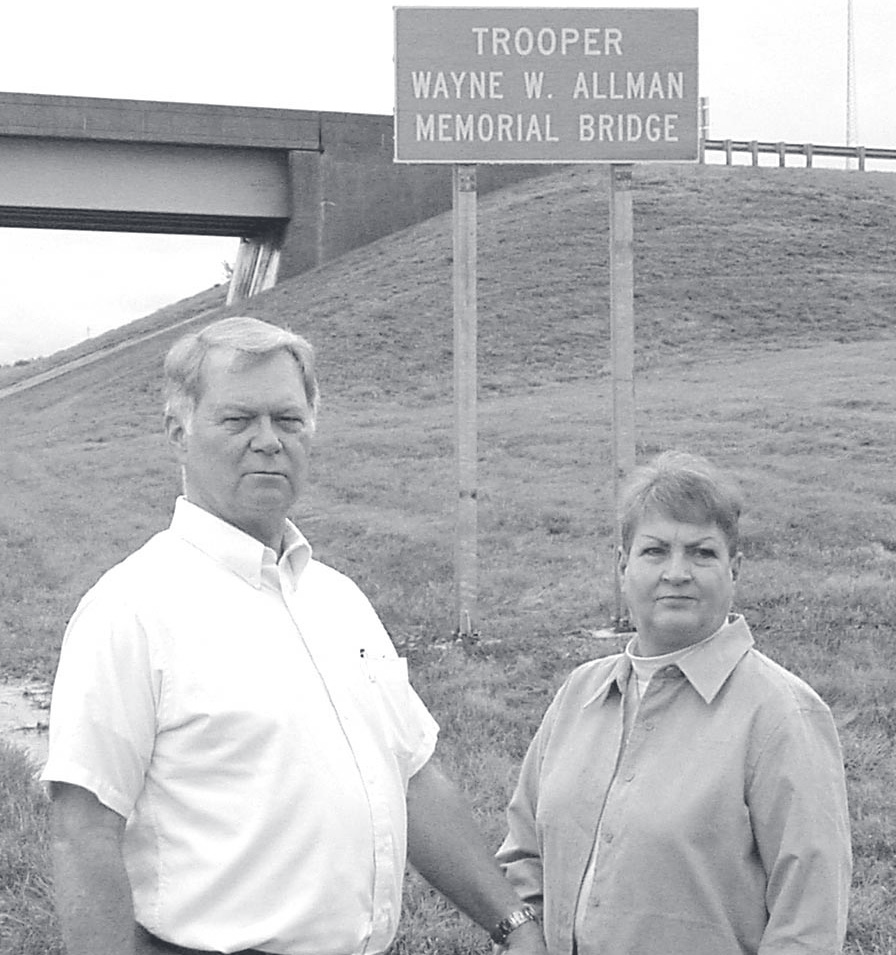
He joined the United States Army, received a regular commission, and was given nine months off each year to attend law school. He graduated from the MU Law School in 1967 as a captain in the U.S. Army. Mr. and Mrs. Gary Allman stand near the Trooper Wayne W. Allman Memorial Bridge after the dedication ceremony. George graduated from MU in 1967 with a bachelor’s of science degree in business and accounting.
In 1968, he graduated with a master’s of science in business and accounting. He became a CPA following graduation. Gary Allman was stationed at the Aberdeen Proving Grounds in 1969, when he volunteered to go to Vietnam with the 101st Airborne. He was assigned to the Judge Advocate General’s Office, near Hue, 400 miles north of Saigon where he dealt with a variety of legal cases involving soldiers in the United States military.
After a year in Vietnam, he was assigned to the Pentagon where he worked in the appellate office. Gary Allman was married while in college, but the marriage dissolved in 1971. A son, Christopher Wayne Allman, was born to the marriage in March 1968. In 1972, Gary Allman married Betty Adkins whom he met in Virginia while stationed there in the service.
In December 1972, a son, Geoffrey Wayne Allman, was born to Gary and Betty. In 1972, Gary Allman was elected prosecuting attorney of Taney County and served in that position until his term expired in 1974. He established a civil law practice and joined a law firm in Branson where he remained until 1997. In 2000, he established a new firm in Branson where he practiced law with the firm of Allman, Ingrum, Wilson, and Akers, LLC.
George Allman married Pamela Gilbert, a piano teacher from Clinton, on August 10, 1968. He served two years in the United States Army assigned to the Finance Center in Indianapolis, IN, beginning in 1969. George and Pam Allman had two children: a daughter, Meredith, born November 20, 1974, and a son, Charles Gilbert, born on Christmas Day 1978. Following his service commitment George worked for a CPA in St. Louis before returning to Clinton.
In 1976, he went to work for the Missouri Department of Mental Health in Jefferson City and took an early retirement in 2000. In August 2004, George moved to Gilbert, AZ, where he became director of finance at Florence Crittenton Services of Arizona Incorporated in Phoenix, AZ. Tpr. Allman’s father, Montie, died on April 18, 1973, at the age of 76, and his mother, Marie, died on December 11, 1984, at the age of 86. They were buried in the Aurora Maple Park Cemetery.
His sister, Loraine Conner, and her husband Robert made their home in Bartlesville, OK. Wava Ruth George Allman died March 6, 2002, and was buried next to Wayne in the Aurora Maple Park Cemetery. In the 47 years following Wayne’s death she made certain she raised her two sons and lived her life in a manner befitting her husband’s sacrifice. Her children and grandchildren all became productive members of society of whom Tpr. Allman would have been proud.
Tpr. Allman was a hero to the citizens of Henry County. Wava Allman was a hero to all who knew her. In the early 1990s, the intersection where Tpr. Allman was killed was replaced with a new, four-lane highway and interchange. During the 2004 Missouri legislative session, State Representative Rex Rector of the 124th District in Cass County passed a resolution dedicating the overpass at the Creighton Interchange to Tpr. Allman.
On October 26, 2004, 49 years after the accident that took his life, a ceremony was held in which the overpass bridge was dedicated as the Trooper Wayne W. Allman Memorial Bridge. Signs at that location now memorialize his life. The bridge stands as a monument to his sacrifice. (Lt. James P. Ripley, Troop A, researched and wrote this profile in 2004.
Ripley retired in 2013.) Trooper Wayne W. Allman was the seventh member of the Patrol to make the Ultimate Sacrifice.
Photos from this Memorial
Additional photographs from the memorial profile.