In Memoriam
Sergeant
Benjamin "Ben" O. Booth
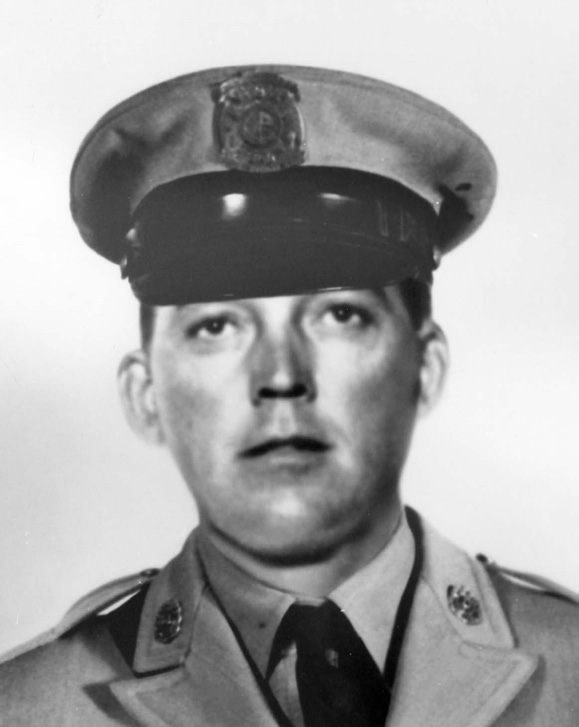
Badge #13 End of Watch: June 14, 1933
Remembrance
Benjamin “Ben” O. Booth was born November 22, 1895, near Santa Fe, MO, the youngest child of John and Alice Booth. He was raised on a farm in Monroe County and graduated from Perry High School in Perry, MO. Booth was married August 18, 1923, to his hometown sweetheart and childhood neighbor, Alice Reed, in Detroit, MI, where he had gone to work for Ford Motor Company. Booth served in the United States Army in 1917 and 1918 during World War I. A son, Wesley Reed Booth, was born to the marriage on September 30, 1924, and a daughter, Alice Owanna Booth, was born December 6, 1925. Booth affectionately referred to his son and daughter as “Monk” and “Pussum.”
Booth served as an officer with the Columbia, MO, Police Department, but immediately became interested in the Missouri State Highway Patrol when he learned of its creation. Booth was an original member of the Missouri State Highway Patrol and attended the academy in St. Louis, MO, as part of the First Recruit Class. Upon graduation from the academy, Booth was made a sergeant and assigned to Columbia, MO, where he and his extended family lived at 708 Rangeline Drive. Sergeant Booth’s in-laws had lost their residence in the depression and moved in with Sgt. Booth and his family.
On the morning of June 14, 1933, Sgt. Booth enjoyed his day off with his children, Benjamin “Ben” O. Booth Wesley and Owanna, at the J.C. Penney’s store in Columbia, MO. Sgt. Booth bought Wesley a pair of shoes and Owanna a green dress with matching pants. Despite the desperation of the times, Sgt. Booth also bought his young daughter a black, Scottie dog pull along toy. Owanna played with the toy as soon as she arrived home. Sgt. Booth was called to work on his day off to man a roadblock at the intersection of U.S. Highway 40 and U.S. Highway 63, just north of the Booth residence following a bank robbery in Mexico, MO. Sgt. Booth was joined at the roadblock by Boone County Sheriff Roger Wilson.
At the roadblock Sgt. Booth approached a 1932 Ford V-8 Coupe on the passenger side. As he tried to open the door, Sgt. Booth was shot in the left leg by the passenger. Sheriff Wilson approached the car and fired once, but was killed by a shot to the head through the windshield. As Sheriff Wilson was shot, Sgt. Booth had pulled the passenger from the vehicle and was struggling with him.
The driver ran around and shot Sgt. Booth in the back, causing Sgt. Booth to release his grip. To ensure Sgt. Booth’s death, the passenger returned to the car, got his weapon, held it against Sgt. Booth’s prone body, and fired again. The two weapons used on Sgt. Booth and Sheriff Wilson were a .38-caliber revolver and a .45-caliber, semi-automatic pistol. Witnesses at the scene were able to obtain a partial license number on the vehicle as it fled east from the scene.
Sgt. Booth was transported to the hospital by patrol car. Reportedly, he was able to push himself up in the seat with his elbow as he was driven past his residence. The Booth children had been playing in the yard the day of their father’s murder, and saw and heard the emergency equipment move into and out of the area. Sgt. Booth died en route to the hospital.
A neighbor, Rose Christian, whose children were playing in the Booth’s yard with Wesley and Owanna, came over to the Booth residence and called her children home. Mrs. Christian’s husband, Sport, who was a firemen, came over to the Booth residence and told them Sgt. Booth had been killed. Sgt. Booth and Sheriff Wilson lay in state in the Boone County Courthouse rotunda so the public could pay its respects. Sgt. Booth’s body was later moved to the Booth residence before the funeral at the Christian Church in Columbia.
Sgt. Booth was laid to rest in Columbia Memorial Park Cemetery. The murders of Sgt. Booth and Sheriff Wilson occurred just three days before the infamous Kansas City Massacre at Union Station in Kansas City, MO. Due to that fact, the investigation initially focused on the involvement of Pretty Boy Floyd. After several months of undercover operations by members of the Patrol, Captain Lewis Means was able to identify two other men as the killers. Francis McNeilly was questioned in Iowa by Capt. Means and confessed to the crime.
McNeilly implicated George McKeever, who was being held in prison in South Dakota. McNeilly was sentenced to prison and McKeever was publicly hanged on December 18, 1936, in Fulton, MO. Sgt. Booth’s family was left to put the pieces of their lives back together starting only with the $2.50 Sgt. Booth had in his pockets when he was killed. Sgt. Booth’s widow, Alice, was faced with a future of two children, two live-in parents, and no income. There were no death benefits for Patrol members at the time.
The Booths owned a Graham-Paige automobile, however, Mrs. Booth had never learned to drive. The vehicle was eventually sold to pay bills. Other troopers in the area would drive Mrs. Booth to the store or deliver groceries on their patrol motorcycles. Mrs. Booth attended night school for six weeks to learn bookkeeping.
After completing night school, Mrs. Booth got a job with the state in Jefferson City. She would ride a bus to and from Jefferson City, then be home for a short time before she walked to and from her night job at Eagle Dairy in Columbia. Mrs. Booth would leave home in the morning at 6 a.m. and return from her night job at approximately 10 p.m. each day. Mrs. Booth paid Sadie Washington $5 a week to take care of the children during the time she was working.
Mrs. Booth made sure her children had a meal every night. According to Owanna, in 1934, Mrs. Booth ate mashed crackers in milk for supper every evening. Owanna Booth was 12 years old when she heard her mom tell Sadie Washington, “If it wasn’t for those kids, I’d go jump in a lake. I’m so tired.”
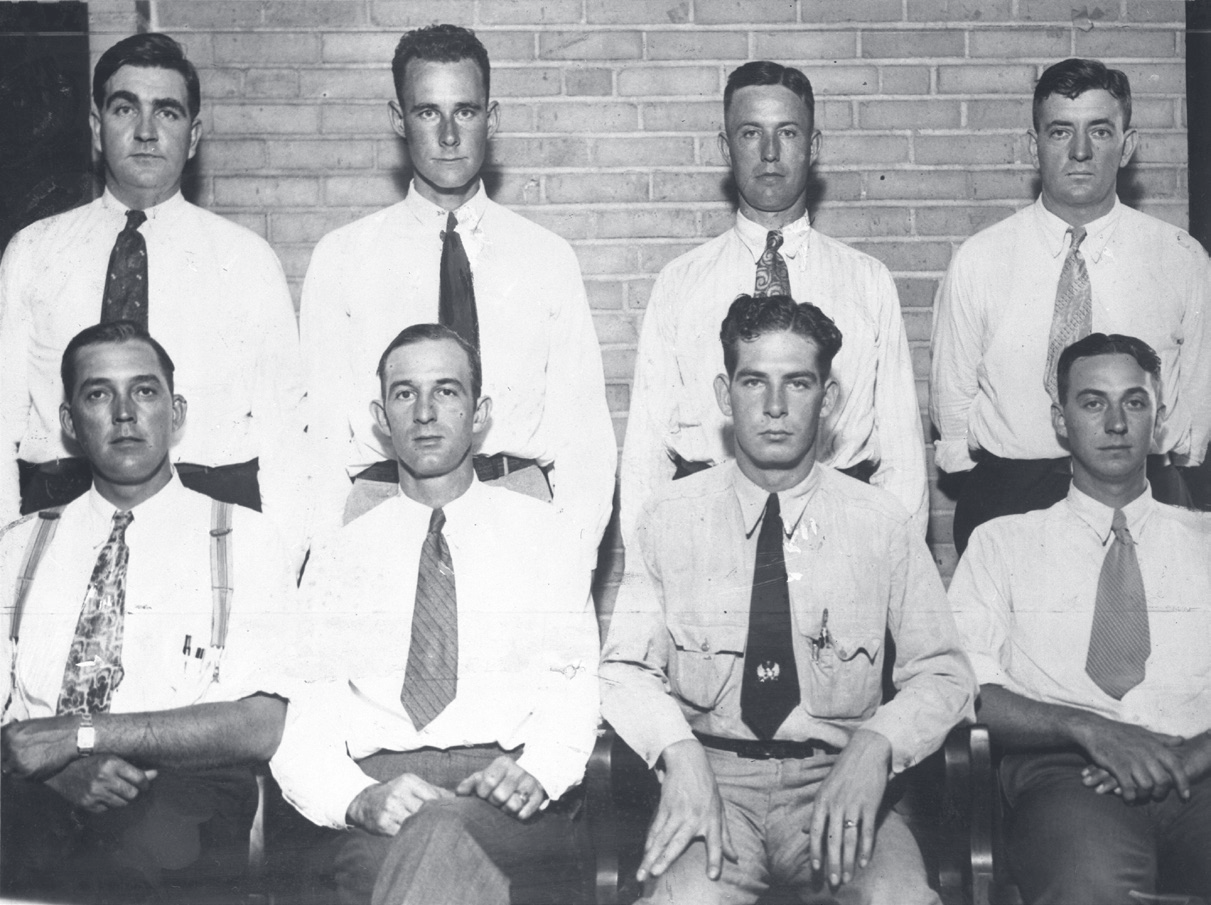
Owanna made a commitment at that The First Recruit Class was photographed in groups of seven or eight, as in the photo above. Recruit Ben Booth is seated, the first man on the left. time to take care of her mother for the rest of her life. Alice Booth ended up living with Owanna and her family the last 25 years of her life. Alice Booth was determined to make her way in the world with the limited resources available to her and her family.
On the day that Owanna graduated from high school, her mother asked her to stop by the funeral home and pay the last 50 cents due for Sgt. Booth’s funeral. Sgt. Booth was described as a dedicated, family man who would give children rides in his motorcycle sidecar when he was a Columbia police officer. On one occasion Sgt. Booth and a Columbia police officer were sent to dispatch two goats that had been left tied to a fence by a traveling circus. Sgt. Booth and the officer decided that rather than destroy the goats they would each take one home.
The Booth goat was named “Old Bill.” Sgt. Booth built a cart for the goat to pull to the icehouse. Upon returning from the icehouse, Sgt. Booth would let “Old Bill” pull the children around in the yard before he disconnected the goat from the cart. Wesley Booth became an architect for Better Homes and Gardens Magazine in Des Moines, Iowa, and died in 1992.
Wesley had three children, two daughters and a son, whom he named Ben Booth. Owanna Booth became an accountant for Federated Funeral Directors and married Wayne Allen, a newspaper, movie and television critic who died in 1996. The Allens had three children, two sons and a daughter. Owanna Booth Allen died in 2009.
Alice Booth died April 25, 1983, one day after Sheriff Wilson’s widow died on April 24, 1983, nearly 50 years after the murders. After her mother’s death, while going through her mother’s things, Owanna Booth Allen discovered a letter that crumbled in her hand when she opened it. Within the letter were four $10 bills with a note that read, “Take this so the children can have Christmas.” The letter was signed by Troopers A.R. Cushman, J.G. McCann, R.G. Breid, and P.C. Burge.
Owanna never again played with the toy Scottie dog she had been given by her father on the day of his murder. It remained encased in glass in her living room. (Lt. James P. Ripley, Troop A, researched and wrote this profile in 2004. Lt. Ripley retired in 2013. 2008 marked the 75th anniversary of the death of Sgt. Ben Booth.
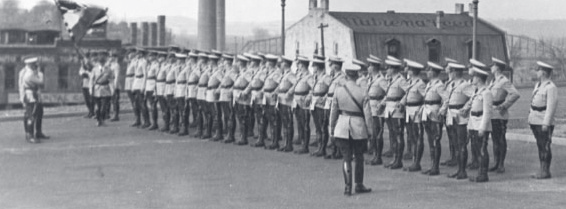
To recognize his sacrifice, the Patrol’s Officer of the Year Award was renamed the Benjamin Oliver Booth Officer of the Year Award.) The First Recruit Class prepares for graduation ceremonies on November 5, 1931.
Photos from this Memorial
Additional photographs from the memorial profile.